
Bench Warrants in Bee County
“Bench warrant” is a practical name for court-directed arrest process tied to a missed setting or other failure to comply. In Bee County, the trigger may be a missed plea date, a missed hearing, contempt, bond forfeiture, or an unpaid judgment. A family or civil matter can have its own court process and should not be sent to the Beeville traffic portal.
The county plea sheet warns that failing to plead by the appearance date can lead to a warrant, an added violation-of-promise-to-appear charge, and a driver-license renewal denial. For a capias pro fine, Texas law adds hearing and hardship safeguards. The court that issued the process must explain what applies to the specific case.
Bee County Missed-Date Bench Warrant Process
A citation names the court and the appearance date. If no plea or appearance is made by that date, the court may add a failure-to-appear consequence and issue process under its rules. The county’s older JP plea sheet describes mail-in plea steps and warns about a warrant; confirm current deadlines with the precinct clerk before relying on an old form.
The county does not publish one grace period or one recall fee for every court. A reset request, a show-cause hearing, or a payment arrangement may be available only through the issuing court.
How a Bee County Bench Warrant Is Issued
The judge or authorized magistrate directs the next step after the missed obligation appears in the case. A bench warrant is tied to an existing case; it is not the same process as a new probable-cause arrest warrant. The sheriff, a constable, or city police may serve court process, depending on the case and jurisdiction.
Bee County has no verified public countywide warrant list showing every court’s process. A new order may remain in its issuing court’s file, and no source reviewed gives a countywide update schedule. Call the clerk to learn whether the warrant is still active and what filing or appearance is required.
Bee County Files Follow Court Levels
The 36th, 156th, and 343rd District Courts handle the district felony layer, with criminal file inquiries through the District Clerk. Bee County Court misdemeanor matters go to the County Clerk’s Criminal Department, which specifically keeps NISI and bond-forfeiture records. A traffic or Class C case may instead sit in one of four JP courts or Beeville Municipal Court.
Ask the clerk for the exact label in the docket, such as bench warrant, capias, capias pro fine, or NISI. The County Clerk Criminal Department describes its misdemeanor and NISI record role.
Bee County Bench Warrant vs Arrest Warrant
A bench warrant follows a court obligation in an existing case. An arrest warrant begins with a magistrate’s probable-cause review of an alleged offense. Texas uses “capias” for a separate court writ to bring an accused person before the court. The Bee County arrest warrant process has its own issuance and service route.
| Feature | Bench Warrant | Arrest Warrant |
|---|---|---|
| Trigger | Missed court setting or other noncompliance | Probable cause for an offense |
| Who Issues It | Judge handling the existing case | Authorized judge or magistrate |
| Underlying Case | Case already set for a required act | Complaint or charged offense |
| How It Clears | Court appearance, reset, or recall | Bond, appearance, or court order |
Bee County Capias Pro Fine Safeguards
A capias pro fine is not just another name for an arrest warrant. It is justice- or municipal-court process tied to an unpaid judgment and costs. Texas Code of Criminal Procedure Chapter 45A includes a hearing on undue hardship and a chance to appear voluntarily and make a good-faith effort to resolve the debt before the court uses that process.
Bee County sources publish no one-size payment or community-service amount. Ask the JP or municipal clerk whether the judge requires financial information, a show-cause hearing, payment plan, community service, or another statutory option.
The city’s Municipal Court page describes its role in Beeville traffic and ordinance cases.
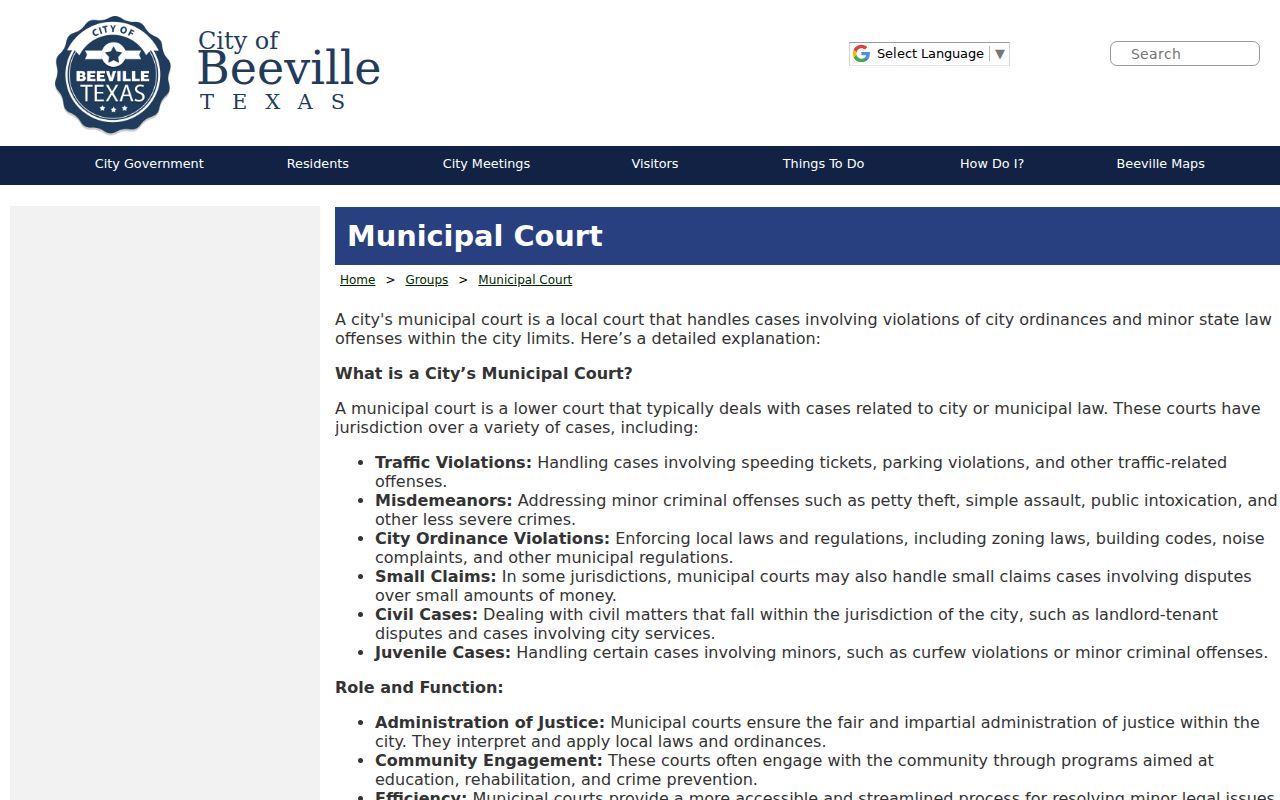
The city page covers Beeville matters; a JP court controls its own capias process.
How to Resolve a Bee County Bench Warrant
Call the issuing clerk before going to the courthouse or jail. No official Bee County source reviewed publishes a general safe-surrender window, walk-in schedule, or standard bond table. A lawyer can ask the court about recall, quash, reset, bond, or an arranged appearance and help confirm which documents to bring.
- Match the process to the case number and court named on the citation or docket.
- Ask whether the court requires a personal appearance, a motion, bond, payment, or a new date.
- For a capias pro fine, ask about the Chapter 45A hearing and hardship procedure.
- Keep the court’s written order, payment receipt, bond paper, or email and confirm the next setting.
Caution: Do not assume a warrant has expired or that a payment removed it. Confirm current status and the remaining case duty with the issuing court.
Bee County Court Must Confirm the Reset
A clerk can explain filing, payment, and docket mechanics, but cannot promise that a judge will recall process. The public District Clerk page lists criminal inquiries and docket-call functions; the County Clerk identifies misdemeanor criminal paperwork and NISI files. No universal motion-to-recall form or filing fee was located for Bee County.
For a planned appearance, ask whether counsel can arrange a walk-through, whether booking may occur, and where a bond is accepted. The Sheriff/Jail can confirm its service or custody path, not the court’s ruling.
Bee County Bench Calls Need Court Name
The District Clerk lists criminal inquiries at Room 30 in the courthouse, weekdays from 8 a.m. to 4:30 p.m., with a lunch closure. The County Clerk’s Criminal Department is in Room 108 and has different daily hours. Those separate counters reflect the split between district cases and County Court misdemeanor files.
For a bench-warrant question, give the clerk the case number and court name before making a trip. The District Clerk contact page and County Clerk Criminal Department list the current office details.
Which Bee County Court Issued It
The precinct on a traffic citation points to the JP clerk. Beeville city citations go to Municipal Court at 405 N. Saint Mary’s. County Court misdemeanor files go to the County Clerk at Room 108; district criminal questions go to the District Clerk at Room 30 in the courthouse. The four JP courts also have separate phone lines, and two are outside Beeville.
Use the case number and court name to route a status request. The Bee County JP directory lists precinct contacts. A judge in the issuing court, not the Sheriff/Jail, decides whether a warrant is recalled.